


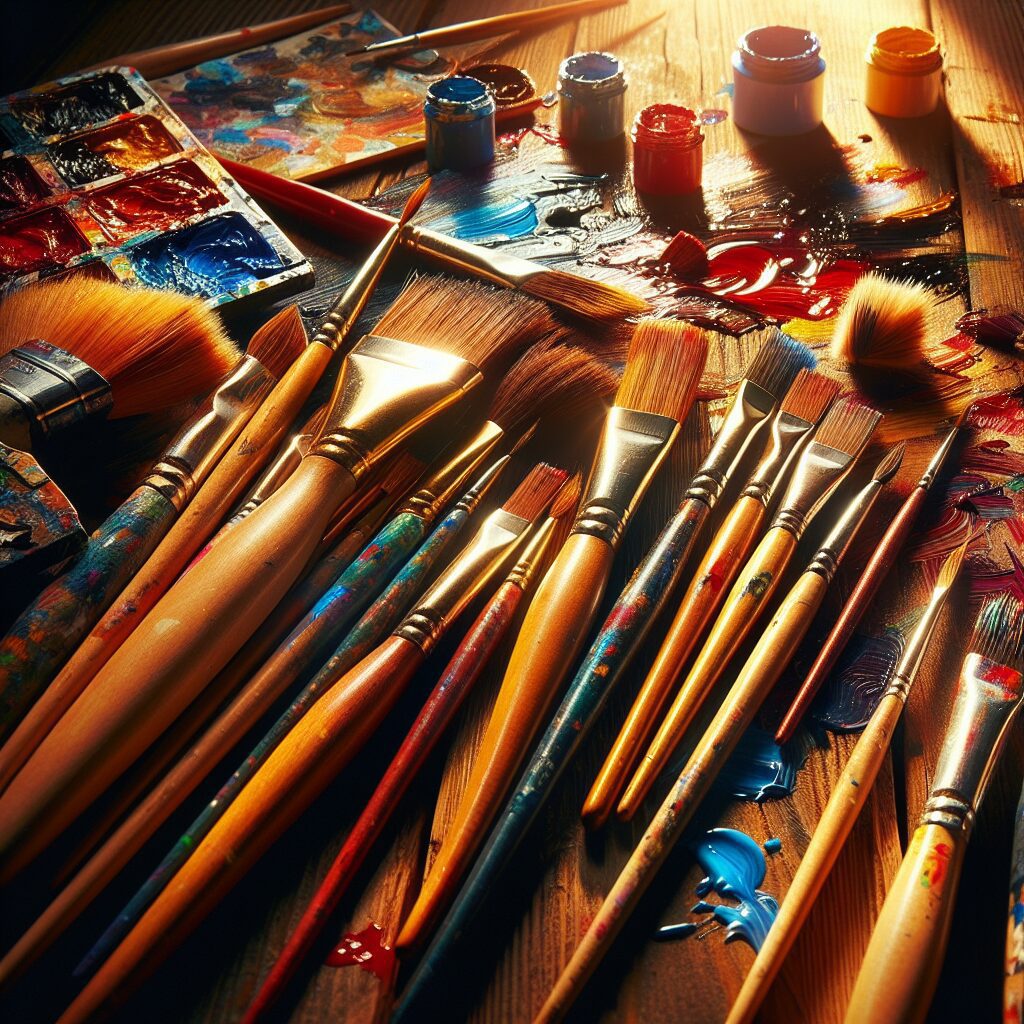
Every painting begins long before the first recognizable tree, cloud, flower, wave, or pathway appears on the canvas.
It begins with a mark.
A broad sweep of color across the background. A broken touch suggesting distant foliage. A thin movement becoming a branch. A soft transition disappearing into mist. A confident highlight catching the edge of a wave.
At URARTSTUDIO, brushes aren’t simply accessories we reach for after deciding what to paint. They are part of the creative process itself. Many of the painting techniques you see throughout our acrylic painting tutorials depend on the relationship between brush shape, pressure, movement, paint load, angle, and the texture of the canvas. Change any one of those elements and the same brush can produce an entirely different result.
🖌️ Explore URARTSTUDIO Artist Brushes:
https://urartstudio.com/product-category/brushes/
The important idea behind our approach is simple:
We don’t always choose a brush because of what we’re painting. We often choose it because of the mark we want to create.
And that difference can completely change the painting process.
🎨 A Brush Is More Than a Tool for Moving Paint
When beginning artists look at a brush, they often think about its assigned purpose. A fan brush is for trees. A small brush is for details. A larger brush is for backgrounds.
But brushes become much more interesting when you stop thinking about them only by category and begin thinking about what their bristles can physically do with paint.
A brush can drag, tap, twist, flick, glide, or scrape lightly across the texture of the canvas. It can deposit a heavy opaque mark or leave behind an almost transparent broken trace of color. Turn the same brush sideways and the mark changes. Reduce the pressure and it changes again. Remove most of the paint and suddenly the brush begins creating completely different textures.
This experimentation is closely connected to the way we approach painting at URARTSTUDIO. Rather than forcing every object into a carefully drawn outline, we often allow the brushstroke itself to suggest the object.
Sometimes you don’t need to paint every leaf. You need the right combination of marks to make the viewer believe thousands of leaves are there.
🌳 How Brushes Influence the Way We Paint Trees
Trees are a perfect example. Imagine trying to paint a large tree by carefully drawing and filling every visible leaf. Technically, it could be done, but the process could become extremely slow—and the result might actually feel less natural.
Our approach is often very different.
We begin by thinking about the tree as a collection of larger shapes. Where is the main foliage mass? Where are the darkest interior areas? Where does the sky break through? Which branches are important enough to show? Where does sunlight touch the foliage?
Once those larger relationships are established, brushwork begins doing much of the visual work. Irregular tapping can suggest clusters of leaves. Broken marks can allow darker underlayers to remain visible. Lighter pressure can create delicate outer foliage, while stronger pressure produces heavier masses.
Rotate the brush occasionally and the pattern changes. Suddenly, you’re not painting one leaf after another. You’re building the visual impression of foliage.
🌳 Explore More Acrylic Painting Tutorials:
https://urartstudio.com/category/painting-instructions/
🖌️ The Brush Shouldn’t Reveal Its Pattern
One challenge with expressive brushes is repetition. Suppose you discover a beautiful foliage mark. You make it once, then again, and again. Before long, the viewer no longer sees foliage—they begin seeing repeated impressions of the brush.
That’s why variation matters so much in our painting process.
Change the angle. Rotate the brush. Alter the pressure. Use a different portion of the bristles. Overlap one mark with another. Leave an opening. Make one cluster dense and another sparse.
The objective isn’t perfect randomness. It’s controlled irregularity.
Nature contains repetition, but nature rarely looks stamped. This idea applies not only to trees but also to grasses, flowers, rocks, clouds, water, bark, and many other landscape textures.
🖌️ Explore URARTSTUDIO Brushes:
https://urartstudio.com/product-category/brushes/
🌿 Why We Don’t Want Every Brushstroke to Be Perfect
Something interesting happens when a brushstroke becomes slightly unpredictable. The bristles separate. Paint catches the canvas unevenly. One portion deposits more color than another, while a little of the darker layer underneath remains visible.
At first, these marks may appear imperfect. Step back from the painting, however, and those irregularities can become exactly what makes the surface feel natural.
This is especially important when painting organic subjects. A tree shouldn’t look manufactured. Grass shouldn’t resemble a repeated decorative pattern. Rock texture shouldn’t look printed. Ocean foam shouldn’t consist of identical white marks.
Nature is full of variation. Instead of correcting every imperfect mark, we sometimes allow those irregularities to participate in the painting.
Ask yourself: Does this brushstroke need to be perfect—or does it simply need to feel right within the painting?
🌊 Painting Water Is About Movement
When painting water, the brush isn’t simply applying blue paint. It is helping describe the direction and behavior of the surface.
Longer horizontal movements can establish calm water. Broken horizontal marks can suggest reflections and small ripples. Curved, energetic movements can begin forming waves. A lighter touch can suggest distant movement, while stronger foreground marks can bring water visually closer to the viewer.
Ocean waves introduce another layer. The brushwork may transition from broad underlying shapes into increasingly energetic movement as the wave develops. Darker passages establish volume. Lighter strokes begin describing reflected light. Broken accents and carefully placed highlights can suggest foam and spray.
Rather than drawing every drop of water, the brush creates a visual vocabulary of movement.
🌊 Explore Acrylic Painting Lessons & Inspiration:
https://urartstudio.com/category/painting-instructions/
☁️ Softer Brushwork Creates Atmosphere
Not every brushstroke should demand attention. Some of the most important marks in a painting are barely noticeable.
Consider a distant mountain. If we paint it with the same sharp edges, heavy texture, and contrast as a foreground tree, the mountain may appear much closer than intended.
So the brushwork changes. Edges become softer, shapes become broader, texture becomes quieter, and color transitions become less aggressive.
The brush isn’t simply painting a mountain—it is helping establish how far away that mountain feels.
This is one reason brush control matters so much in landscape painting. A strong, broken mark can come forward, while a soft, restrained mark can disappear into the distance.
🌫️ Sometimes the Best Brushstroke Is the One You Barely Make
Painters naturally concentrate on what they’re adding, but pressure matters just as much as paint.
Try loading a brush and barely allowing the bristles to touch the surface. Then increase the pressure slightly. Press more firmly and the mark changes again, even though you’re using exactly the same brush and paint.
Instead of constantly changing brushes, you can change the relationship between the brush and the canvas.
This becomes especially useful for delicate foliage, grasses, atmospheric textures, highlights, water reflections, and areas where you want the underpainting to remain visible.
🎨 Paint Load Changes Everything
A brush heavily loaded with acrylic paint behaves differently from an almost-empty brush. A heavily loaded brush can produce strong, opaque passages, while the same brush begins producing increasingly broken marks as the paint leaves the bristles.
Those later marks can be beautiful.
Instead of immediately reloading, continue using the brush as its paint supply decreases. One brush load can create a natural progression:
Strong mark → broken mark → delicate texture → almost-dry suggestion
This can be especially useful when creating organic surfaces because the variation happens naturally.
💡 Explore More Painting Tips & Techniques:
https://urartstudio.com/painting-tips/
🪨 Dry-Brush Effects Can Suggest More Than They Describe
Acrylic painting doesn’t always require smooth, complete coverage. An almost-dry brush moving lightly across the canvas can catch the raised texture while skipping lower areas, creating irregular broken marks without requiring you to paint every piece of texture individually.
Think about rock. Instead of drawing every crack, a few broken lighter strokes across a darker foundation can suggest a rough surface.
Think about tree bark. A darker trunk with selective broken highlights can suddenly begin feeling textured.
The same principle can work beautifully for weathered walls, pathways, distant fields, old wood, and other textured surfaces.
The brush allows the surface itself to participate in the painting.
🌾 Grass Doesn’t Need Thousands of Individual Blades
A meadow containing thousands of grasses doesn’t require thousands of carefully painted lines.
Start with the larger field and establish the underlying colors and values. Then use directional texture to suggest vegetation. As the grasses approach the foreground, a few more individual strokes can become visible. Some can overlap, others can bend, and a few can catch highlights.
The eye begins interpreting all of those marks as an enormous field of grass.
This principle appears throughout expressive painting:
Give the viewer enough information—and allow the imagination to complete the rest.
🖌️ Browse URARTSTUDIO Artist Brushes:
https://urartstudio.com/product-category/brushes/
🌹 Painting Flowers: Suggestion Before Description
Flowers present a similar challenge. It’s tempting to paint every petal, and sometimes that’s appropriate—particularly around a focal point. But a garden containing hundreds of flowers can quickly become overloaded if every blossom receives equal attention.
Instead, establish larger masses of color first. A few more recognizable flowers can then emerge from those shapes. Selected lighter marks suggest petals catching the light, tiny dark interruptions create separation, and a few stems or leaves provide additional structure.
From a distance, the viewer sees a flower-filled garden. Up close, many of those flowers may actually consist of only several expressive marks.
That’s the magic of brushwork.
🖌️ Why Brush Size Matters
One of the easiest ways to accidentally overwork a painting is to reach for a tiny brush too early.
Small brushes encourage small thinking. You begin seeing leaves instead of trees, cracks instead of rocks, blades instead of fields, and ripples instead of water. Before long, the painting contains enormous amounts of information but lacks strong overall structure.
Larger brushes encourage you to establish major relationships first: the sky, land, largest dark masses, light, and focal point.
Once those decisions are established, smaller marks become much more meaningful.
This is an important part of our creative approach:
Big shapes first, smaller information later.
🎯 The Right Brush Can Help You Stop Overpainting
Sometimes an artist spends fifteen minutes creating something that the right brushstroke could suggest in seconds.
That’s not about painting faster simply for the sake of speed. It’s about efficiency of expression.
If several irregular marks can convincingly suggest foliage, why paint hundreds of individual leaves? If one broken stroke creates beautiful bark texture, why draw every crack? If several horizontal marks create convincing reflections, why reproduce the entire shoreline upside down?
Brushwork allows us to simplify, and simplification can actually make a painting stronger because it leaves room for the viewer to participate.
🎨 Our Brushes and Our Painting Style Develop Together
An artist chooses brushes according to their painting style—but over time, brushes can also influence the development of that style.
Discover an unusual mark and suddenly you begin imagining where it could be used. Perhaps it resembles foliage. Perhaps it creates an interesting wave. Maybe it produces a texture that would be perfect for a rocky cliff, flower field, or dramatic sky.
The tool begins inspiring the painting.
This creates a creative loop:
The painting influences the brush choice → the brush creates an unexpected mark → the mark inspires a new painting decision.
That interaction is part of what keeps the process interesting.
🖌️ See the Brushes We Offer at URARTSTUDIO:
https://urartstudio.com/product-category/brushes/
🧪 Experiment Before You Paint
One of the best ways to understand a new brush is to experiment with it before using it on an important painting.
Take a scrap surface and see what happens when you load the brush heavily, remove some paint, turn it sideways, tap it, drag it, twist it, use only the edge, barely touch the surface, press harder, or allow the paint to gradually run out.
You’re building a mental library of textures.
Later, while painting, you may suddenly recognize:
“That mark would be perfect here.”
This is much more useful than simply memorizing that a particular brush is “for trees” or “for grass.”
🌳 One Brush, Many Possibilities
Here’s an exercise we strongly recommend: choose one brush and challenge yourself to create as many natural textures as possible without changing it.
Can you suggest foliage, grass, bark, rock, clouds, water, or flowers?
You may not love every result—and that’s fine. The purpose is to discover how much the mark changes when you alter pressure, angle, movement, moisture, and paint load.
You may discover that a brush you rarely used simply needed to be approached differently.
🌐 Find More Painting Ideas & Tutorials:
https://urartstudio.com/category/painting-instructions/
🖌️ Why We Keep Returning to Specialty Brushwork
Acrylic landscapes contain enormous amounts of visual information: thousands of leaves, countless blades of grass, rock texture, cloud formations, reflections, waves, flowers, and branches.
Trying to describe all of this literally can make painting exhausting.
Specialty and expressive brushwork give us another option. Instead of describing every object, we can suggest complexity through texture.
The viewer sees the result as much more complicated than the individual marks actually are. That is one of the most satisfying aspects of expressive acrylic painting—a simple physical gesture can create the illusion of something far more elaborate.
👀 The Painting Is Meant to Be Viewed From More Than Six Inches Away
When you’re extremely close to the canvas, expressive marks may appear abstract. A foliage stroke looks like paint. A water reflection looks like a horizontal line. A rock texture looks like a broken scrape. A flower may be only two or three touches of color.
Now step backward.
The marks connect. The tree appears. The water begins reflecting. The rock becomes solid. The garden fills with flowers.
This is why we frequently encourage artists to step back while painting.
You’re not creating a collection of individually perfect brushstrokes. You’re creating an overall visual experience.
🖼️ Look Closely at an Original Painting
Original paintings can be excellent teachers of brushwork because you can examine both the illusion and the marks that created it.
From across the room, you experience the complete scene. Move closer and you begin noticing individual decisions—the direction of a stroke, a broken edge, thick paint, a barely visible glaze, dry-brushed texture, or a surprisingly simple highlight.
Move backward and those individual marks disappear into the image again.
🖼️ Explore URARTSTUDIO Original Paintings:
https://urartstudio.com/product-category/original-paintings/
🎥 Watch the Brushes in Action
Reading about brushwork is useful, but watching a painting develop can reveal something words cannot fully explain: timing.
When does the artist switch from broad shapes to smaller marks? When is a brush reloaded? When is pressure reduced? When is an area deliberately left alone? When are the strongest highlights introduced?
Watching these decisions unfold helps reveal that painting technique isn’t simply a collection of isolated tricks. It’s a sequence of decisions.
🎨 Explore Our Acrylic Painting Tutorials & Inspiration:
https://urartstudio.com/category/painting-instructions/
💡 Don’t Ask Only “Which Brush Should I Use?”
This is one of the most useful changes an artist can make.
Instead of asking “Which brush paints trees?”, ask “What kind of mark would make this tree feel natural?”
Instead of asking “Which brush paints water?”, ask “What movement should these reflections have?”
Instead of asking “Which brush should I use for rocks?”, ask “Do I need a sharp edge, broad plane, broken texture, or tiny accent?”
Now you’re thinking like a painter rather than simply matching tools to objects.
The brush becomes a means of expression.
🎨 Brushes Don’t Replace Technique—They Expand It
A specialty brush isn’t a shortcut that magically creates a finished painting. The artist still needs to make decisions about composition, value, color, light, atmosphere, edges, and placement.
What a useful brush can do is expand the vocabulary of marks available to you.
It can help create textures that would be difficult or tedious with another shape. It can encourage looser painting, introduce irregularity, help you work larger, and make certain gestures feel more natural.
But the brush becomes most powerful when you understand why you’re making the mark in the first place.
That’s where tool and technique come together.
🌟 The Brushstroke Becomes Part of the Painting’s Personality
Two artists can use the same colors, paint the same subject, and even use the same brush—and produce completely different paintings.
Why?
Because the brush responds to the person holding it. Pressure is different. Speed is different. Timing is different. Movement is different. The amount of paint is different.
One artist may create delicate, controlled marks while another produces energetic, broken textures.
That’s why learning a brush isn’t simply learning a mechanical technique. Over time, the brush becomes connected to your own visual language.
🖌️ Why URARTSTUDIO Brushes Are Connected to What We Create
For us, the relationship between brushes and paintings is natural because the two belong to the same creative process.
The brushes support the kinds of marks we enjoy exploring in acrylic painting: expressive foliage, textured landscapes, atmospheric passages, grasses, trees, water, flowers, highlights, and the countless irregular details found throughout nature.
But the real goal isn’t simply to own another brush.
It’s to discover what you can make the brush do.
Experiment with pressure. Change your angle. Rotate the bristles. Use more paint, then less. Try a dry-brush effect. Make one confident stroke and resist correcting it. Allow some marks to remain imperfect.
Then step backward and see what happens.
You may discover that the brushstroke you almost erased is exactly the mark that makes the painting feel alive.
🖌️ Explore URARTSTUDIO Artist Brushes:
https://urartstudio.com/product-category/brushes/
❤️ From Our Brushes to Your Paintings
One of the most rewarding parts of creating art is knowing that a simple tool can become part of someone else’s creative process.
A brush begins as a tool. Then an artist picks it up, and it becomes a tree, a crashing ocean wave, a distant mountain, a field filled with flowers, a glowing sunset, a mysterious pathway—or perhaps something we would never have imagined.
That’s where the brush truly becomes meaningful: not sitting beside the palette, but covered in paint and helping turn an idea into something visible.
So the next time you pick up a brush, don’t think only about what it was designed to do.
Ask:
What else can this brush do?
Experiment. Turn it. Tap it. Drag it. Let the paint run out. Change your pressure and allow the marks themselves to become part of the creative process.
Because sometimes the most exciting paintings begin not with a perfectly planned image…
…but with an unexpected brushstroke.
Happy Painting! 🎨🖌️❤️
URARTSTUDIO Team
🎨 Continue Creating With URARTSTUDIO
🖌️ Explore URARTSTUDIO Artist Brushes:
https://urartstudio.com/product-category/brushes/
🌐 More Acrylic Painting Tutorials & Inspiration:
https://urartstudio.com/category/painting-instructions/
💡 Painting Tips & Techniques:
https://urartstudio.com/painting-tips/
🎨 Acrylic Painting Tutorials:
https://urartstudio.com/category/acrylic-painting-tutorials/
📚 URARTSTUDIO Art Blog:
https://urartstudio.com/category/blog/
🖼️ Explore Original Paintings:
https://urartstudio.com/product-category/original-paintings/
🏠 Visit URARTSTUDIO:
https://urartstudio.com/
From Brush to Canvas: How URARTSTUDIO Brushes Became Part of Our Acrylic Painting Process
Discover how URARTSTUDIO artist brushes connect directly with our acrylic painting process and expressive painting style. Learn how brush shape, pressure, angle, paint load, dry-brush techniques, and creative experimentation can help create trees, foliage, water, flowers, atmosphere, texture, and expressive landscape effects.
Keywords: URARTSTUDIO brushes, acrylic painting brushes, artist brushes, acrylic brush techniques, expressive brushwork, landscape painting brushes, painting foliage, painting trees, acrylic painting techniques, dry brush painting, acrylic landscape painting, painting tutorials, artist painting tips
#URARTSTUDIO #AcrylicPainting #PaintBrushes #PaintingTechniques #ArtistBrushes #LandscapePainting




Leave a Reply
You must be logged in to post a comment.